Interview by Aude Camus
I moved flat in early 2025, needing an extra room to welcome our second baby, after five beautiful years in the apartment where our first daughter was born. And when it came time to leave, saying goodbye to the security guards felt unexpectedly heavy.
Almost… guilty.
Guilty to leave them behind — because they had been so kind to us, and because, in their quiet way, they had witnessed so many chapters of our life. Us coming home from the hospital as brand-new parents, a tiny baby girl in our arms. Us leaving for France during the pandemic, unsure when we’d make it back to Hong Kong. Our struggle with luggage every time we travel back to France for the summer months.
They had seen it all.
And yet, as I stood there saying goodbye, it struck me that while they knew so much about our lives, I knew almost nothing about theirs.
There are people we pass every day without really seeing them. The security guard at the entrance of your building. The cleaner who arrives before the city wakes up. The woman who has been standing behind the same counter for years, quietly watching life unfold.
Hong Kong Shifts was born from one of those everyday blind spots — and from a simple realisation that quietly changed everything.
I moved flat in early 2025, needing an extra room to welcome our second baby, after five beautiful years in the apartment where our first daughter was born. And when it came time to leave, saying goodbye to the security guards felt unexpectedly heavy.
Almost… guilty.
Guilty to leave them behind — because they had been so kind to us, and because, in their quiet way, they had witnessed so many chapters of our life. Us coming home from the hospital as brand-new parents, a tiny baby girl in our arms. Us leaving for France during the pandemic, unsure when we’d make it back to Hong Kong. Our struggle with luggage every time we travel back to France for the summer months.
They had seen it all.
And yet, as I stood there saying goodbye, it struck me that while they knew so much about our lives, I knew almost nothing about theirs.
There are people we pass every day without really seeing them. The security guard at the entrance of your building. The cleaner who arrives before the city wakes up. The woman who has been standing behind the same counter for years, quietly watching life unfold.
Hong Kong Shifts was born from one of those everyday blind spots — and from a simple realisation that quietly changed everything.


(c) Bradley Aaron
Maxime and Cynthia met while working at the same law firm. Like many good things, their project didn’t start with a grand plan or a five-year strategy, but with a conversation. Maxime mentioned that he had been passing the same security guard in his building for years without knowing anything about her. He wanted to photograph her and capture her portrait in her work environment. Cynthia, who speaks Cantonese, suggested combining it with an interview to learn her story. That is how Hong Kong Shifts started.
They didn’t set out to create a platform, a book, or a long-running social project. They just wanted to talk to one person.
No script, just curiosity
They didn’t set out to create a platform, a book, or a long-running social project. They just wanted to talk to one person.
No script, just curiosity


After this first encounter with Mei Fung, the security guard working in Maxime’s building, the duo set up to approach different workers.
They started walking neighbourhoods they didn’t know well, particularly in Kowloon and the New Territories, and simply approached shift workers. No casting. No selection process. Whoever said yes became part of the story.
The early days weren’t easy. Cynthia describes herself as naturally shy, and approaching strangers in Hong Kong doesn’t exactly come naturally. “At the beginning, we probably had eight rejections out of ten,” she says. “Now it’s more the other way around.”
The shift didn’t come from confidence alone, but from learning how to connect — how to read people, how to speak differently depending on who is in front of you, how to match energy, tone, even Cantonese register.
“There are scales of Cantonese,” she explains, laughing. “Speaking to a construction worker isn’t the same as speaking to a bakery owner. You adjust. You meet people where they are.” Maxime adds that curiosity plays a role too. When people see a local woman with a Westerner holding a camera, they pause. They wonder. Showing respect and curiosity often opens the door.
Dignity first, always
They started walking neighbourhoods they didn’t know well, particularly in Kowloon and the New Territories, and simply approached shift workers. No casting. No selection process. Whoever said yes became part of the story.
The early days weren’t easy. Cynthia describes herself as naturally shy, and approaching strangers in Hong Kong doesn’t exactly come naturally. “At the beginning, we probably had eight rejections out of ten,” she says. “Now it’s more the other way around.”
The shift didn’t come from confidence alone, but from learning how to connect — how to read people, how to speak differently depending on who is in front of you, how to match energy, tone, even Cantonese register.
“There are scales of Cantonese,” she explains, laughing. “Speaking to a construction worker isn’t the same as speaking to a bakery owner. You adjust. You meet people where they are.” Maxime adds that curiosity plays a role too. When people see a local woman with a Westerner holding a camera, they pause. They wonder. Showing respect and curiosity often opens the door.
Dignity first, always


From the start, one value has guided everything they do: dignity.
Every person they speak to has their story published — unless they explicitly say they’re uncomfortable. There’s no filtering for “better” narratives, no editing for drama. The goal isn’t exposure; it’s recognition.
For many of the people they interview, this is the first time a stranger has ever asked them about their life — or taken their portrait. “One gentleman teared up when we brought him his photo,” Cynthia recalls. “He showed it to his neighbours on the street. He was so proud.”
Another interviewee, a restaurant owner in Sai Kung whose family has been there for generations, proudly showed the Hong Kong Shifts book to guests at every table when Maxime and Cynthia returned with a copy.
Some connections are harder to maintain. Not everyone has a phone. Some only have a correspondence address. But whenever they organise community events, they invite their interviewees — not as subjects, but as people they’ve built relationships with.
What they refuse to do is turn the project into a spectacle. “We’re not organising human safaris,” Maxime says. “The message is simple — go and get your own story.”
From the street to the classroom — and beyond
Every person they speak to has their story published — unless they explicitly say they’re uncomfortable. There’s no filtering for “better” narratives, no editing for drama. The goal isn’t exposure; it’s recognition.
For many of the people they interview, this is the first time a stranger has ever asked them about their life — or taken their portrait. “One gentleman teared up when we brought him his photo,” Cynthia recalls. “He showed it to his neighbours on the street. He was so proud.”
Another interviewee, a restaurant owner in Sai Kung whose family has been there for generations, proudly showed the Hong Kong Shifts book to guests at every table when Maxime and Cynthia returned with a copy.
Some connections are harder to maintain. Not everyone has a phone. Some only have a correspondence address. But whenever they organise community events, they invite their interviewees — not as subjects, but as people they’ve built relationships with.
What they refuse to do is turn the project into a spectacle. “We’re not organising human safaris,” Maxime says. “The message is simple — go and get your own story.”
From the street to the classroom — and beyond


Over time, Hong Kong Shifts grew organically. From social media posts to exhibitions. From bus shelters to a published book. From street encounters to classrooms, NGOs, and corporate spaces.
In schools, Maxime and Cynthia run storytelling workshops focused not on journalism or photography, but on soft skills — the ones rarely taught, but deeply needed. “How do you approach and connect with a stranger? How do you deal with rejection? How do you make people feel comfortable speaking to you?” Cynthia says. “These are things we learned on the street.”
One question they ask students always surprises them: How often do you speak to your neighbours? “The overwhelming answer is: never,” Maxime says. “And they genuinely don’t understand why they would.”
That disconnect — that quiet loneliness — is at the heart of why Hong Kong Shifts exists.
It’s also why the project eventually moved into corporate spaces. In one campaign, they displayed portraits and stories in a trading room — including one of the building’s reception staff.
“People suddenly realised they knew her kids’ names,” Maxime says. “They’d worked in the same building for years and never really gotten to know her.”
Culture, they believe, isn’t built through policies or slogans — but through small, human moments.
The stories that stay
In schools, Maxime and Cynthia run storytelling workshops focused not on journalism or photography, but on soft skills — the ones rarely taught, but deeply needed. “How do you approach and connect with a stranger? How do you deal with rejection? How do you make people feel comfortable speaking to you?” Cynthia says. “These are things we learned on the street.”
One question they ask students always surprises them: How often do you speak to your neighbours? “The overwhelming answer is: never,” Maxime says. “And they genuinely don’t understand why they would.”
That disconnect — that quiet loneliness — is at the heart of why Hong Kong Shifts exists.
It’s also why the project eventually moved into corporate spaces. In one campaign, they displayed portraits and stories in a trading room — including one of the building’s reception staff.
“People suddenly realised they knew her kids’ names,” Maxime says. “They’d worked in the same building for years and never really gotten to know her.”
Culture, they believe, isn’t built through policies or slogans — but through small, human moments.
The stories that stay


When asked if there’s one story that has stayed with them, both hesitate. Not because there aren’t any — but because there are too many.
Still, Maxime mentions a security guard at a private members' club in Central whose job is to stand at the entrance for nine hours a day. No chair. No desk. Just stillness. “I don’t know how he does it,” he says. “Construction work is physically hard, but you’re building something. Standing there all day, watching people pass by — that felt incredibly challenging.”
Cynthia recalls interviews that required entirely different forms of connection — speaking with people with autism or Down syndrome, or interviewing two deaf brothers through written notes and gestures. “It wasn’t about perfect communication,” she says. “It was about connection.”
No five-year plan — and that’s the point
Still, Maxime mentions a security guard at a private members' club in Central whose job is to stand at the entrance for nine hours a day. No chair. No desk. Just stillness. “I don’t know how he does it,” he says. “Construction work is physically hard, but you’re building something. Standing there all day, watching people pass by — that felt incredibly challenging.”
Cynthia recalls interviews that required entirely different forms of connection — speaking with people with autism or Down syndrome, or interviewing two deaf brothers through written notes and gestures. “It wasn’t about perfect communication,” she says. “It was about connection.”
No five-year plan — and that’s the point


Despite the book, the recognition, and the growing visibility, Maxime and Cynthia still both have careers in addition to the project. Hong Kong Shifts has always lived alongside life — on weekends, between commitments, carried by passion rather than pressure.
They’ve consciously let go of rigid schedules and expectations.“If we don’t feel it one week, we pause,” Maxime says. “We want to stay authentic.”
They don’t have a five-year plan. The project evolves by staying open — to opportunities, to pivots, to letting the work take on a life of its own.“It feels like you’re just helping something grow,” Maxime reflects. “And I love that.”
In a city that moves fast, Hong Kong Shifts asks us to slow down. To look up. To ask a question. To notice the people who hold the city together, one shift at a time. And maybe — just maybe — to start a conversation of our own.
They’ve consciously let go of rigid schedules and expectations.“If we don’t feel it one week, we pause,” Maxime says. “We want to stay authentic.”
They don’t have a five-year plan. The project evolves by staying open — to opportunities, to pivots, to letting the work take on a life of its own.“It feels like you’re just helping something grow,” Maxime reflects. “And I love that.”
In a city that moves fast, Hong Kong Shifts asks us to slow down. To look up. To ask a question. To notice the people who hold the city together, one shift at a time. And maybe — just maybe — to start a conversation of our own.

About Hong Kong Shifts, the book
Click the pick for more info and stockists
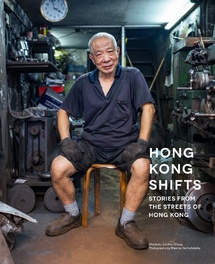
From sampan ladies and bamboo scaffolders to street cleaners, fishermen, security guards and market vendors – these workers form the backbone of the fast-paced metropolis of Hong Kong, yet they are often overlooked or taken for granted. Looking beyond the glamorous harbourfront, neon-lit shopping districts and dramatic skyline, Hong Kong Shifts explores the back alleys to meet and learn from the individuals who work tirelessly to keep the city ticking. These are stories and portraits of resilience, wisdom, positivity and strength from the streets of Hong Kong.
Published in July 2024 by Blacksmith Books, the hardcover book is bilingual (English and Cantonese) and presents a selection of 50 colourful human stories from across Hong Kong. These stories have been collected since 2019 throughout the pandemic and document a unique chapter of Hong Kong's history - paying tribute to this city and its people.
Click the pick for more info and stockists
From sampan ladies and bamboo scaffolders to street cleaners, fishermen, security guards and market vendors – these workers form the backbone of the fast-paced metropolis of Hong Kong, yet they are often overlooked or taken for granted. Looking beyond the glamorous harbourfront, neon-lit shopping districts and dramatic skyline, Hong Kong Shifts explores the back alleys to meet and learn from the individuals who work tirelessly to keep the city ticking. These are stories and portraits of resilience, wisdom, positivity and strength from the streets of Hong Kong.
Published in July 2024 by Blacksmith Books, the hardcover book is bilingual (English and Cantonese) and presents a selection of 50 colourful human stories from across Hong Kong. These stories have been collected since 2019 throughout the pandemic and document a unique chapter of Hong Kong's history - paying tribute to this city and its people.


